Chapter 1: The Birth of Money and Its Spread Around the World
Before money: exchange was personal
Long before coins or bank accounts, people exchanged goods directly. Grain could be traded for tools, animals for land, labor for protection. This worked inside small communities, but it was slow and limited. A farmer who needed shoes had to find a shoemaker who also wanted grain at that exact moment. Economists call this the double coincidence of wants. In daily life it meant friction. Trade needed memory, reputation and trust before it needed money.
Commodity money: useful things became units of value
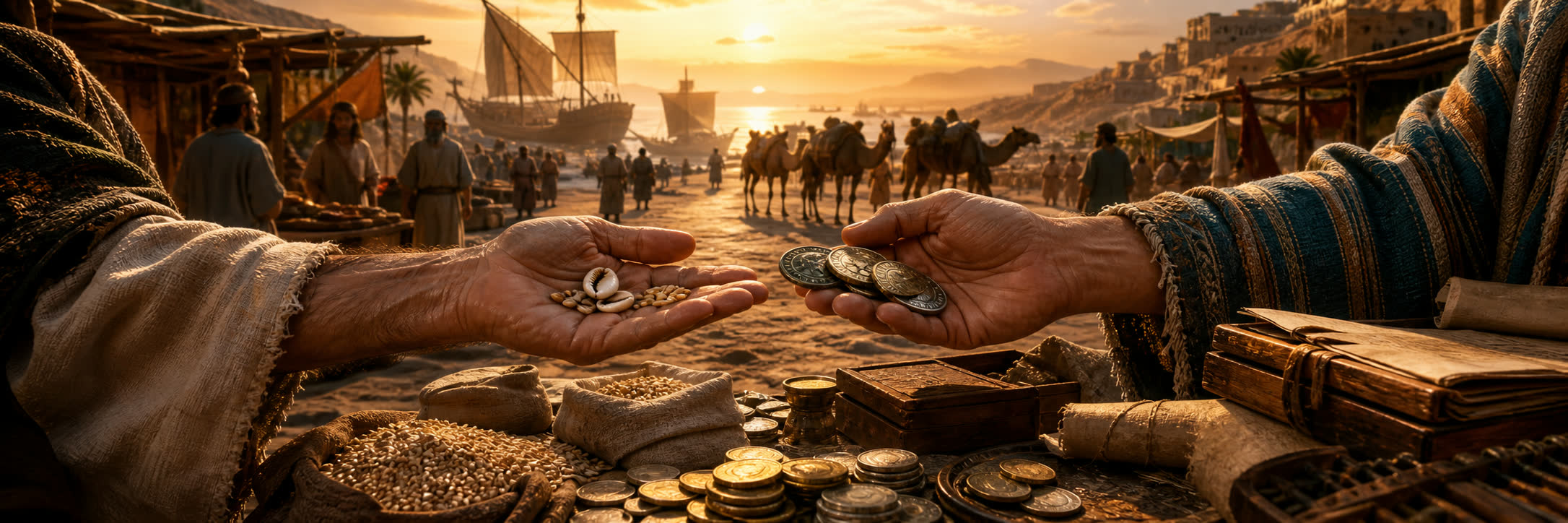
As trade grew, certain goods became common reference points. Cattle, salt, shells, grain, cocoa beans and metal were used because people already valued them. They were not abstract tokens at first. They had practical use, social meaning or scarcity. Commodity money solved one problem: people could accept something today because they believed someone else would accept it tomorrow.
Metal and coins: money became portable authority
Metals changed the scale of exchange. Gold, silver and copper were durable, divisible and easier to carry than grain or livestock. When rulers began stamping coins, money gained a public face. A coin was not only metal. It was a promise that the issuer stood behind its weight and purity. This made trade faster, but it also connected money to power. Whoever controlled the mint could shape trust, taxes and armies.
Paper money: trust became lighter than metal
Paper money began as a practical receipt. Merchants and travelers did not want to move heavy metal across dangerous roads, so deposit notes and bills of exchange became useful. Over time, paper promises became money themselves. China used paper money early, and later European banking houses developed bills, notes and credit instruments that allowed value to move across regions without moving piles of coins.
Banks and states: money became infrastructure
Modern money expanded with banks, central banks and state finance. Banks created credit. States collected taxes and paid armies. Central banks tried to stabilize currencies and manage crises. Money became more than a thing people held. It became infrastructure: ledgers, laws, reserves, payment networks and political trust. The more complex the economy became, the more money depended on systems people could not see directly.
Global spread: trade routes carried money ideas
Money spread through trade routes, empires, ports and migration. Silver moved between the Americas, Europe and Asia. Colonial currencies reshaped local economies. The gold standard later tried to link national currencies to a shared metal base, while the twentieth century moved toward fiat money: currency backed not by direct metal redemption, but by state authority, productive economies and public confidence.
The lesson of chapter 1
Money began as a practical answer to trade friction. It became a story of trust, power and networks. Every new form of money made exchange easier, but also created new risks: debasement, bank failure, inflation, exclusion and political control. That pattern still matters in digital finance today.