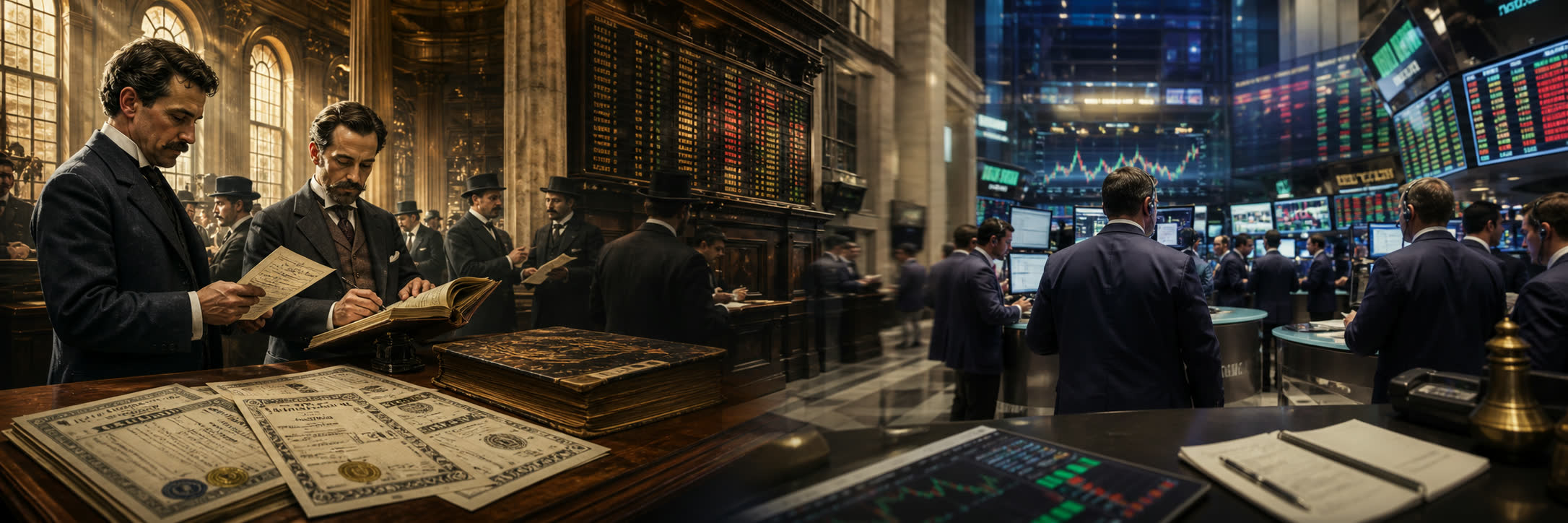
Chapter 2: Stock Exchanges, Shares and the Rise of Market Trading
The problem of big ventures
Ships, mines, railways, factories and global trade required more capital than most individuals could provide alone. Large projects were risky and expensive. Investors needed a way to share risk without personally managing every voyage or warehouse. The answer was the share: a claim on part of a business or venture.
Joint-stock companies: risk became divisible
Joint-stock companies allowed many investors to own small parts of a large enterprise. If a voyage succeeded, profits could be shared. If it failed, losses were limited to each investor position. This was a major financial invention. It turned ownership into something that could be split, priced and transferred.
Exchanges: markets needed a meeting place
As shares, bonds and bills became common, traders needed organized places to meet. Early exchanges grew in commercial cities where merchants already gathered. Amsterdam became famous for active share trading in the seventeenth century. London, Paris, New York and other centers followed with their own institutions, rules and rituals.
Price discovery: markets became public conversation
A stock price is not only a number. It is a compressed argument about the future. Buyers and sellers disagree, news changes expectations, and liquidity decides how quickly prices move. Exchanges created a public arena where belief, fear, information and capital met every day. This is why markets can look rational in one moment and emotional in the next.
Bonds, banks and speculation
Stock exchanges never existed alone. They grew beside banks, government debt, insurance and commodity markets. Bonds financed states and infrastructure. Banks lent against assets. Speculators searched for short-term gains. Sometimes this produced real growth. Sometimes it produced bubbles. The South Sea Bubble, railway manias and later crashes showed that markets can amplify both innovation and illusion.
Modern trading: speed changed the game
In the twentieth and twenty-first centuries, trading moved from paper tickets and shouting floors to electronic order books. Information began traveling at machine speed. Index funds, derivatives, high-frequency trading and global platforms made markets broader and faster. Ordinary people gained access, but professional speed and data advantages also became larger.
The lesson of chapter 2
Stock markets turned ownership, debt and expectation into tradable instruments. They made capitalism more scalable, but also more sensitive to narrative, leverage and panic. The idea that value can be represented, priced and traded globally prepares the ground for digital assets.